
Walking Through the Door
What jiu jitsu has taught me about the other side of discomfort, about building trust, and about unexpected ways we contribute and belong.
I sat in my car for fifteen minutes, hands gripping the steering wheel, staring at the door I was supposed to walk through.
It was my first jiu jitsu class and my entire system was screaming at me to leave. Do you really need to know how to defend yourself? Is that even necessary? Why are you doing this again?
I was alone, which made it worse. Usually when I try something new, I have a partner in crime—someone to lean on, someone to share the awkwardness with. Not this time. This was just me, myself, and the very real possibility of embarrassment without a safety net.
I told a few of my close friends I was doing it, specifically so I couldn't back out. Accountability has always been my biggest motivator. If I knew they were going to ask me how it went, I had to go.
I checked the clock. If I didn't go in now, I'd be late. And being late for your first class somehow felt worse than being awkward.
Every step toward that door was heavy. And I still walked through it.
Trust, Fast-Tracked
The warm-ups started, and they just included me.
No special "new person" treatment. No awkward explanations. We jumped right into drills like I'd always been part of the group. My partners were patient, helping me figure out the techniques, smiling when I messed up. We even laughed.
I was terrible. But I wasn't alone in it. Everyone's a little lost their first class.

#mytrustedtribe
Over the next few weeks, the women in the group became familiar faces. Then friends. Then something more. We started sharing Spindrifts and lingering after class—it became so frequent we all started taking turns keeping the mini-fridge stocked with new flavors to try. A local competition came to town, so we went together, not to compete, just to watch and spend time together off the mat.
Most people think trust takes years to build. This group blew that theory apart. Trust arrived in that first class and fast-tracked from there to today—I trust these women more than some people I've known my entire life.
But trust doesn't fast-track skill development. No one newer than me had walked through that door yet, so I had nobody to test my growth against. I was still the "new girl." Still learning slower than I wanted to. Still getting humbled, week after week. Most days it didn't feel like I was making any tangible progress at all—let alone an impact.
Finding the courage to walk through that door for the first class, scared as I was, changed something in me. Showing up stopped being about proving I could learn quickly and keep up—because I couldn't. That's not how this sport works. Two months in, that showing up meant something. Just not what I expected.
The First Stripe
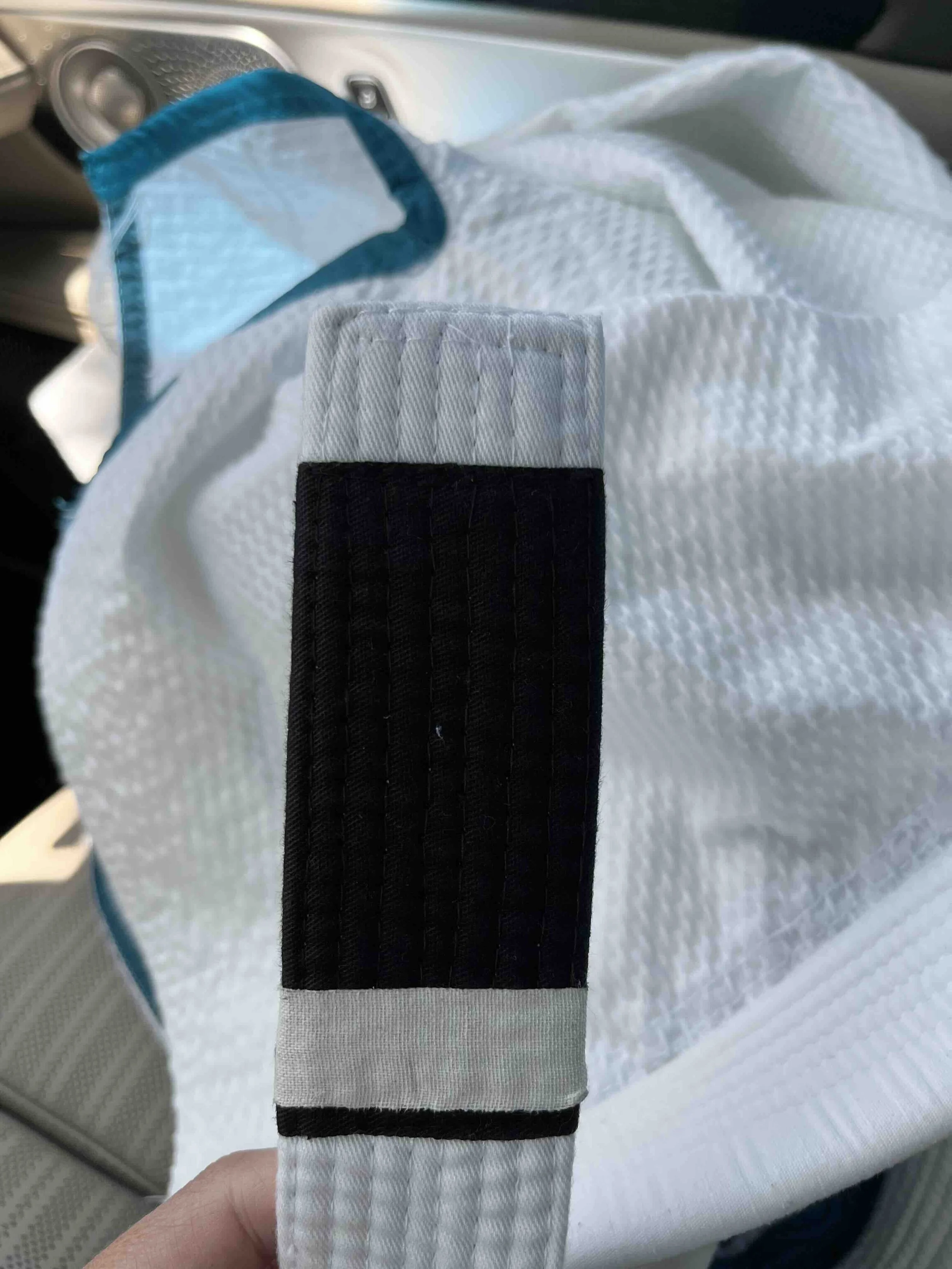
The First Stripe
The belt promotion ceremony landed right at the two-month mark. I showed up intrigued—excited to watch the others get promoted, to cheer them on.
My coach, a seasoned black belt with over a decade of experience, started calling names.
Mine was first.
I looked behind me to see who she was talking to.
There was no one there. We were the white belts—last row. I'd literally looked backward at nothing.
She had to repeat my name twice. Finally, she said, "Julie, you really need to get up here so we can keep things moving along."
There was quite a chuckle from the room—not really at me, but at my disbelief and her blunt encouragement to get me up there.
I walked up in complete shock. She said something about my hard work, my commitment, how I kept showing up, the progress I'd made in such a short time.
Getting that first stripe on my white belt was completely unexpected. Shocking, honestly. It just didn't make sense to me.
She obviously saw something in me that I didn't see in myself. I would have never given myself that stripe. I honestly felt like an imposter.
But knowing her the way I do now? She doesn't hand things out. There's too much honor in this. She wouldn't have called my name unless I'd earned it.
I just didn't understand yet what I'd really earned it for.
I'd been measuring myself by skill and "winning" on the mat—by that measure, I wasn’t “special” and failing constantly. Skill and technique are definitely part of what she cares about. Apparently, they just weren't all of it.
What I Actually Bring
I am, without question, the least experienced person in the gym. I'm defending myself in almost every roll. I tap (or lose). A lot. But that's okay.
Just when I thought my progress wasn't fast enough and I wasn't helping because I wasn't as good as everyone else, my tribe reminded me they needed me.
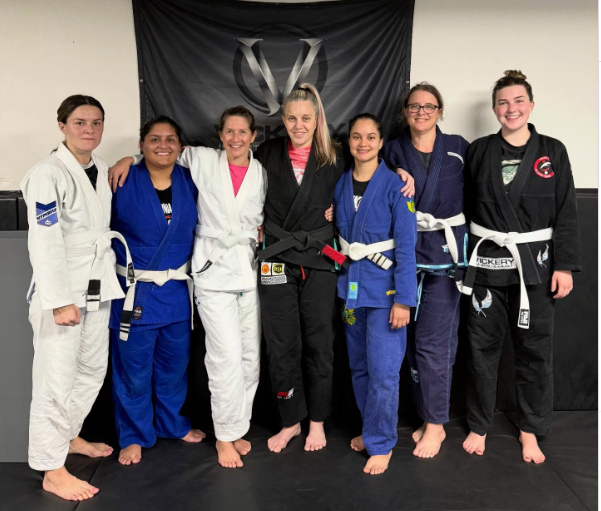
Vickery Jiu Jitsu & MMA | Women’s Class
If I don't show up, that's one less body to train with. One less person to drill with, to grow with, to sweat with, and, yes, to laugh with. My tribe needs me there as much as I need them. It's a give and take.
I learned this when I'd been away from the mat for a stretch. When I came back, my coach messaged me. "It was nice to have you back," she wrote. "You bring so much joy and laughter. I'm so glad you're part of our group."
That meant the world to me. The least skilled person in the room and my presence mattered. Nobody was actually waiting for me to get "good enough" before I belonged. I finally noticed, I already belonged.
So what do I actually bring, if not skill?
I bring a willingness to be visibly bad at something and laugh about it anyway, which gives others the permission to do the same. I keep showing up even when I'm not winning. There's a little bit of the underdog Rudy in it, if you know the story. The significance was never really about talent.
I'm also, functionally, a “body” other people need to get better. They improve by training against me. I improve by training against them. And when they teach me—correcting my technique, walking me through something again—they're not just being generous. Teaching sharpens their own mastery. It serves both of us.
Each person we meet is our teacher and student.
Someone has to be the least experienced person in the room. I'm now consciously doing that job and teaching myself that it's ok being the "student."
I also noticed that my tapping wasn't actually losing. Every roll is a small act of building trust in my own ability to stay safe and strong. I'm one of the older women on the mat, and there's something quietly powerful about proving—mostly to myself—that this kind of demanding physical growth doesn't come with an age limit.
My value in the gym won't come from being the best on the mat. It comes from showing up. From my presence. From how I care for myself and for the women next to me. That's not a lesser form of contribution. It's just a different one than I thought. Than most of us think.
What Door Are You Sitting Outside of Right Now?
I almost didn't walk through that door because I was uncomfortable with potentially not being good at something. And later, I almost stopped showing up for the same reason. Turns out I was needed, trusted, and already belonged both times—no one but myself was waiting for me to be "good enough."
Many people carry that same belief, whether conscious or not. You tell yourself you shouldn't have a seat at the table until you're experienced enough, wise enough, skilled enough. So you hold back. You don't walk through the door because on the other side is the unknown of whether you'll actually matter, and that's scary.
Someone has to be the newest person on the team, at the table, in the role. Show up consistently, even before you feel senior enough to be there. Most times consistency is a contribution all on its own. And, can fast-track building trust.
Remember, competence is not the only means to contribution. You don't have to be the best or most tenured in the room to matter to the people in it. Frankly, as a leader, if you're the smartest person at the table, that's a problem in itself.
Your leadership is most powerful when it can be defined by being both the teacher and the student. Create space to learn from your team's expertise. Be the silent sounding board for someone processing a hard conversation, pressure-testing an idea, or discerning a different solution. Trust that they develop and grow by sharing with and teaching you.
This week, I invite you to notice when you're manufacturing reasons to "stay in the car." Honor your discomfort, tell a colleague your intentions, and summon the courage to open your own jiu jitsu door. There are gifts waiting for you on the other side—you just won't know what they are until you walk through.
You may already know what door you're sitting outside of. The harder question is what's keeping you in the car.
Let's figure that out together — so you can go find out what's waiting for you on the other side.